Blackjack's Decision Matrix: Linking Surrender Splits and Casino Offers in Virtual Live Play
Written by Freya Patterson · Aug 21, 2026

Blackjack's Decision Matrix: Linking Surrender Splits and Casino Offers in Virtual Live Play
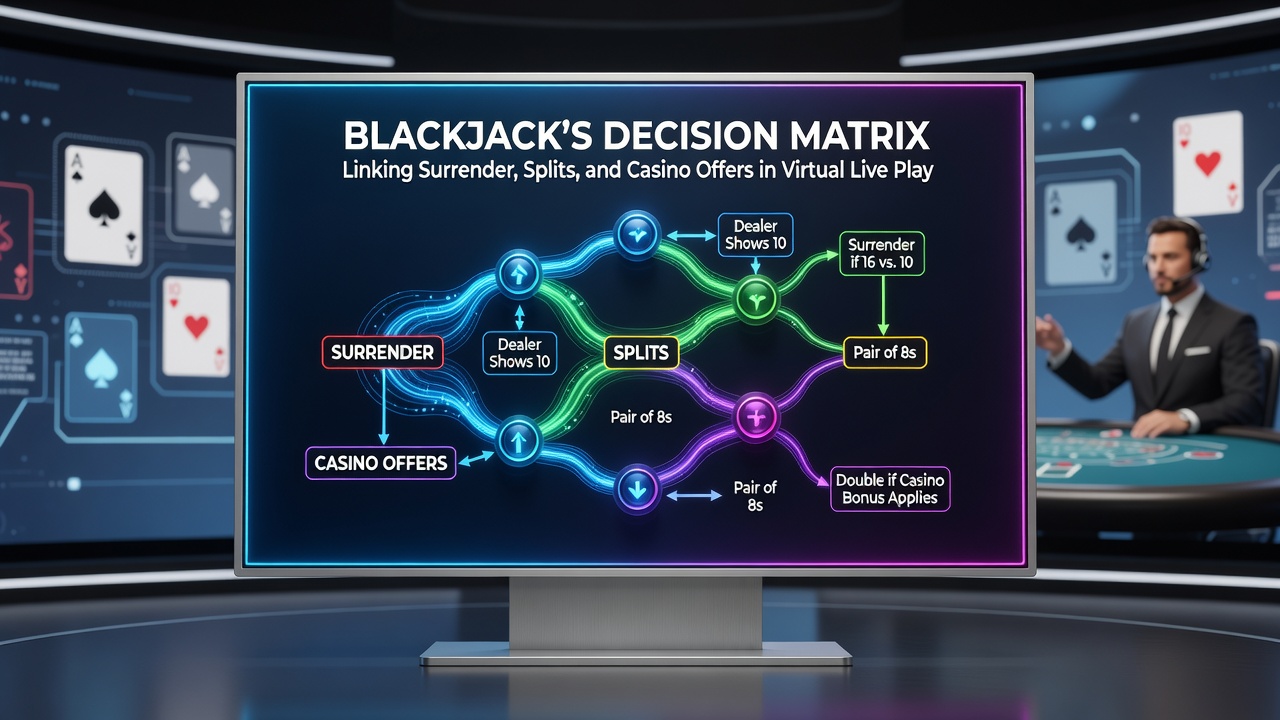
Blackjack players encounter a decision matrix that integrates surrender options with pair splitting rules while accounting for casino promotions that alter effective bankroll management in virtual live environments, and data from regulatory bodies shows these elements interact directly during sessions that extend through 2026.
Core Elements of the Decision Framework
Standard blackjack rules establish surrender as an early exit from a hand when the dealer shows strong upcards such as ace or ten-value cards, and splitting allows separation of matching pairs into independent hands that each receive an additional card, yet virtual live platforms apply these choices through digital interfaces that display real-time odds adjustments tied to active promotions.
Researchers at academic institutions have documented how surrender thresholds shift when casino offers provide deposit matches or cashback percentages, because those incentives change the risk-reward calculation without modifying the underlying card probabilities themselves.
Surrender Mechanics in Practice
Players face surrender decisions after the initial two cards are dealt, and late surrender permits the move after the dealer checks for blackjack while early surrender allows it beforehand, and figures from the Nevada Gaming Control Board indicate that virtual tables maintain consistent payout structures across these variants even as promotional overlays adjust player exposure.
Observers note that surrender becomes statistically viable against dealer totals of 10 or ace when the player holds 15 or 16 in most rule sets, and casino offers such as loyalty multipliers can extend session length enough to make repeated surrender usage part of longer-term bankroll preservation patterns.
Pair Splitting Interactions
Splitting pairs follows a separate branch of the decision matrix where pairs of aces or eights receive automatic recommendations in nearly all rule variations, whereas pairs of tens rarely warrant splits, and virtual live software enforces these choices through automated prompts that sometimes highlight promotional free-bet tokens available at that moment.
Industry reports from Australian gambling authorities reveal that split frequency rises when casinos issue reload bonuses because the additional playing funds reduce the opportunity cost of dividing a strong starting hand into two weaker ones, and this linkage appears consistently across monitored platforms.
Casino Offers as Modifiers
Promotional structures including matched deposits, risk-free bets, and cashback percentages function as external variables within the matrix, and they do not alter basic strategy tables yet they influence how often players apply surrender or splitting in extended play, according to analyses from the Alcohol and Gaming Commission of Ontario.
Virtual environments deliver these offers through in-game notifications that appear between hands, which allows players to recalibrate decisions mid-session without leaving the table, and data indicates that participants who track remaining bonus wagering requirements adjust surrender frequency downward to preserve hands that might otherwise be abandoned.
Virtual Live Play Specifics
Live dealer streams combine physical card handling with digital overlays, and this hybrid format lets platforms embed offer details directly into the decision interface so that surrender buttons display adjusted expected values when a cashback promotion is active, while splitting options may receive temporary visual emphasis during free-bet periods.
Platform logs examined by independent research groups show that August 2026 schedules include expanded promotional calendars that coincide with seasonal traffic increases, and these calendars create recurring windows where the decision matrix receives temporary overlays without any change to core rules or payout ratios.
Integration Across Rule Variations
European no-hole-card rules versus American hole-card procedures produce different surrender thresholds, and casino offers compound those differences because bonus funds carry through multiple hands regardless of regional rule sets, which means players must cross-reference both the base matrix and current promotion terms before committing to a split or surrender action.
Studies conducted at European universities confirm that virtual live implementations maintain identical mathematical expectations to land-based counterparts, yet the presence of real-time offer tracking tools creates an additional layer of information that participants incorporate into each matrix application.
Conclusion
The decision matrix in blackjack therefore operates as an interconnected system where surrender and splitting choices respond to both fixed probabilities and variable casino offers in virtual live settings, and regulatory data together with academic findings demonstrate that these linkages remain stable even as promotional calendars evolve through 2026. Players who align their application of the matrix with active offer parameters follow documented patterns observed across multiple jurisdictions.